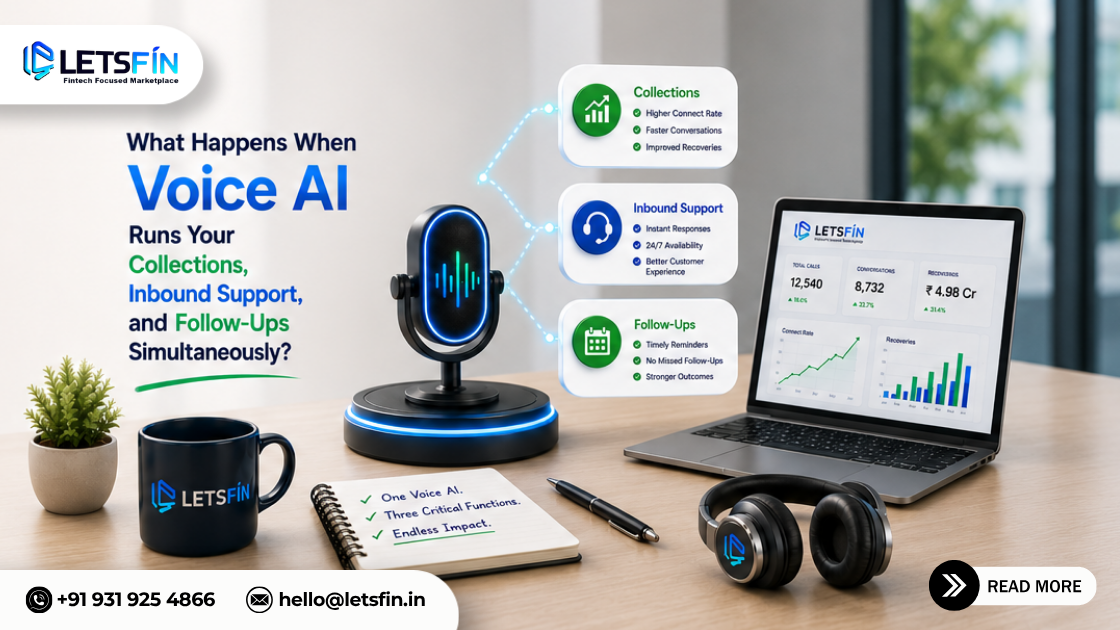
What Happens When Voice AI Runs Your Collections, Inbound Support, and Follow-Ups Simultaneously?
May 11, 2026
Most lending teams think about Voice AI as a collections tool. You point it at a delinquent portfolio, it makes calls, it captures promises to pay. That is the use case that gets talked about most because it has the most obvious ROI.
But that framing misses what makes Voice AI genuinely transformative for an NBFC or digital lender. The real shift happens when the same infrastructure is running your outbound collections, your inbound borrower support, and your follow-up pipeline at the same time, without any of those workstreams competing for the same human resources.
This is what that actually looks like in practice.
Three Workstreams, One Infrastructure, Running in Parallel
Outbound Collections
Every morning your LMS flags accounts that are approaching or past due. Under a human-only model, that list gets distributed to agents, worked in batches, and partially completed by end of day. Accounts at the bottom of the list wait. Follow-up calls get pushed. DPD buckets move.
With Voice AI running outbound collections:
- Every flagged account gets a call on the same day, within the permitted 8 AM to 7 PM window, without batching delays
- Calls are personalised in real time using live LMS data, so the AI is speaking to the borrower about their exact outstanding amount, their specific DPD status, and their payment history
- No-answer accounts are retried within the same compliant window based on each borrower's historical response patterns
- Objections like salary not yet credited, will pay next week, or already paid are handled conversationally without escalating to an agent
- Every connected call is transcribed, outcome-logged, and synced back to the LMS before the collections manager sits down in the morning
Inbound Customer Support
While the outbound engine is working through the delinquent portfolio, borrowers are calling in. Balance queries. Payment confirmation requests. EMI date questions. Dispute submissions. Foreclosure enquiries. Under a human-only model, calls that come in after 6 PM go unanswered. Calls that come in during peak outbound hours compete for the same agent capacity.
Voice AI handles inbound 24 hours a day, 7 days a week:
- Borrowers calling at 9 PM to check their outstanding balance get an immediate, accurate, conversational response
- Payment disputes raised outside business hours are logged and escalated for human review without the borrower having to call back
- Extension and restructuring requests are captured, noted against the account, and queued for agent follow-up the next morning
- Every inbound interaction is recorded, transcribed, and logged in the LMS exactly as outbound calls are
The experience for the borrower is consistent regardless of when they call. The experience for your team is that the inbound queue does not pile up overnight.
Follow-Up Pipeline
This is the workstream that most teams handle least consistently. A borrower commits to paying by the 15th during an outbound call on the 10th. In a human-operated model, that promise-to-pay sits in a spreadsheet or a CRM note. Whether a follow-up call actually happens on the 14th depends on whether the agent remembers, whether their queue allows it, and whether the account gets prioritised over fresher delinquencies.
Voice AI closes this gap entirely:
- Every promise-to-pay captured during an outbound or inbound interaction automatically triggers a follow-up call scheduled for the day before the committed date
- Pre-due reminder calls go out to borrowers whose EMI is approaching but not yet overdue, reducing first-time delinquency before it appears in the collections queue
- Post-payment confirmation calls or messages close the loop with borrowers who have paid, reducing inbound query volume around payment acknowledgement
- The entire follow-up pipeline runs without any manual scheduling or agent intervention
What Changes When All Three Run Together
The individual value of each workstream is clear enough. The compounding effect is what most teams do not anticipate until they see it.
When outbound collections, inbound support, and follow-ups are all running on the same infrastructure simultaneously, a few things happen that do not happen when they are separated:
Every borrower interaction, whether they called in or were called, updates the same LMS record in real time. An agent who picks up a complex case mid-morning already has the full picture of every AI interaction that has happened on that account, inbound and outbound, with timestamps and transcripts.
The human team stops context-switching between reactive inbound queries and proactive outbound work. The AI handles the volume layer of both. Agents handle the cases that genuinely need them.
The compliance architecture covers everything in one place. RBI Fair Practices Code adherence, calling hour restrictions, caller identification, prohibited language, and audit trail generation apply uniformly across every outbound call the system makes and every inbound call it handles. There is no separate compliance process for inbound versus outbound.
Recovery rates improve not just because more outbound calls are being made, but because the follow-up pipeline is actually functioning and inbound borrowers who want to resolve their account are getting an immediate response instead of being lost to a missed call.
The Compliance Layer Across All Three
It is worth addressing this directly because it comes up in every conversation about Voice AI in Indian lending.
The RBI imposed over Rs 48 crore in penalties on NBFCs and banks in FY 2024-25 for collection practice violations. Calls made before 8 AM. Threatening language. Failure to identify the caller. Contact with unauthorised third parties. These violations happen under pressure. An agent working a shortfall at end of day makes different decisions than the same agent would in a calm environment.
Voice AI has no equivalent pressure point. Across all three workstreams:
- Outbound calls are made strictly between 8 AM and 7 PM, every time, without exception
- Inbound calls are handled 24x7 within a script that is architecturally constrained to compliant language and conduct
- Every interaction, inbound or outbound, generates a timestamped, transcribed audit record automatically
- The system identifies itself at the start of every outbound call as required under RBI Fair Practices Code
- No interaction falls outside the compliance perimeter regardless of volume, time of day, or borrower behaviour during the call
For teams that have had compliance findings or are preparing for audits, this is not a secondary benefit. It is a core operational shift.
What Your Team Looks Like After Deployment
The human team does not disappear. It gets redeployed to work that actually requires human capability.
Before Voice AI, a team of 50 agents splits its day between outbound dialling, inbound query handling, and manually tracking follow-up commitments. The majority of that time goes to structured, repeatable conversations that produce the same output regardless of who makes them.
After Voice AI handles the volume layer across all three workstreams, those 50 agents spend their time on:
- Complex restructuring conversations where a borrower's situation requires genuine flexibility and human judgement
- High-value defaults where the recovery amount and relationship justify dedicated senior attention
- Severely delinquent accounts where legal escalation is being evaluated
- Escalated inbound cases where the borrower has specifically requested human assistance after the AI interaction
- Quality review of AI interaction transcripts and outcomes to continuously improve call flows
This is the work human agents are genuinely good at. It is just rarely what they spend most of their day doing under a human-only model.
How Letsfin Tech Makes This Work
Letsfin's Voice AI infrastructure is built specifically for NBFCs, digital lenders, and fintech platforms. It is not a generic voice bot platform that requires months of customisation. The collections workflow logic, LMS connectivity, compliance architecture, multilingual capability, and inbound support functionality are already embedded.
The infrastructure that powers all three workstreams simultaneously includes:
- Real-time LMS integration so every call, inbound or outbound, reflects the borrower's current account status
- Multilingual voice agents across 12 or more Indian languages so no borrower is unreachable due to language
- Dynamic call flows configured by DPD bucket, loan product, and risk profile
- 24x7 inbound handling with full conversational capability across all common borrower query types
- Automated promise-to-pay capture and follow-up scheduling across the entire portfolio
- Full call recording, transcription, and LMS outcome logging for every interaction
- RBI Fair Practices Code compliance built into the architecture across outbound and inbound operations
The Question Worth Asking
If your collections team is working through a delinquent portfolio during the day, your inbound queue is building up after hours, and your promise-to-pay follow-ups are being managed manually, then all three of those problems have the same solution.
The lenders who are deploying Voice AI now are not doing it because it is interesting technology. They are doing it because the first time all three workstreams ran simultaneously on their portfolio, the numbers made it very difficult to go back.
Reach out to the Letsfin team to understand what a full deployment would look like across your collections, inbound support, and follow-up operations, and how quickly the results would show up in your portfolio performance.