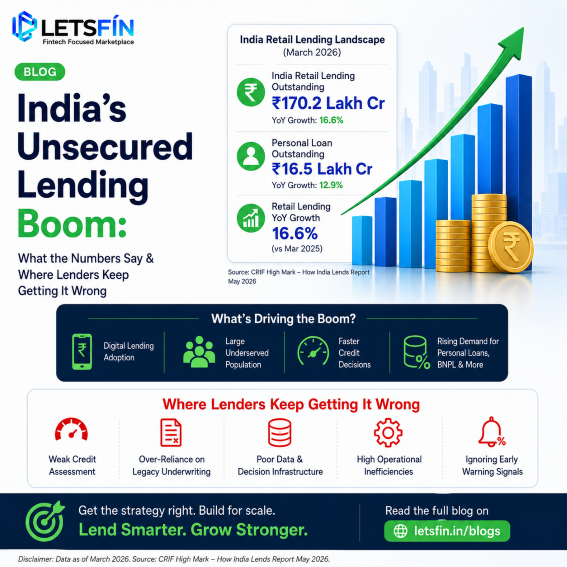
India's Unsecured Lending Boom: What the Numbers Say and Where Lenders Keep Getting It Wrong
July 22, 2026
India's Unsecured Lending Boom: What the Numbers Say and Where Lenders Keep Getting It Wrong
India's unsecured lending market is growing faster than most lenders can build for it. Payday loans, personal loans, BNPL, credit lines — the segment has expanded at a pace that would have seemed unrealistic five years ago. And yet, across the NBFCs, digital lenders, and fintech platforms driving this growth, the same operational gaps keep appearing. The collection infrastructure lags. The onboarding flow creates friction. The risk layer doesn't scale. The opportunity is real. The execution, for many lenders, is still catching up.
The Unsecured Loan Landscape: What Lenders Are Actually Offering
Not all unsecured loans are the same. Tenure, ticket size, and borrower profile vary significantly across product types — and so do the operational challenges that come with each.
Bullet and Payday Loans (Under 30 Days): These are the shortest-duration products in the market — salary advances, bridge loans, emergency credit. Ticket sizes typically range from Rs. 2,000 to Rs. 50,000. The margin per loan is thin, which means volume is everything. A collection failure on a 15-day loan is not a slow burn. It is an immediate hit to the book.
Short-Term Personal Loans (1 to 12 Months): This is the engine of the digital lending boom. Products in this range serve salaried borrowers, gig workers, and small business owners who need credit without collateral and without the wait time of traditional banks. Ticket sizes here range from Rs. 10,000 to Rs. 5 lakh. The competition is intense and the borrower's repayment behaviour is the primary variable lenders are managing.
Medium to Long-Term Unsecured Loans (1 Year and Above): Personal loans with tenures of one to five years, often used for home renovation, medical expenses, or education. These sit at the higher end of the unsecured segment and are primarily the domain of larger NBFCs and digital arms of banks. NPA risk compounds over the tenure, making early warning systems and automated collections critical.
BNPL and Revolving Credit Lines: Buy-now-pay-later and credit lines sit outside the traditional loan classification but represent a significant and fast-growing part of unsecured credit exposure. Repayment behaviour here is closely tied to user experience — and platforms that create friction in repayment see higher delinquency.
How Fast Is This Sector Actually Growing
The numbers are significant. India's personal loan AUM across NBFCs and digital lenders has crossed Rs. 13 lakh crore, growing at a CAGR of approximately 25 to 28 percent over the last three years. The digital lending segment specifically — which covers most of the short-tenure and fintech-first products — has been growing even faster, with several estimates placing it at 35 to 40 percent CAGR.
Payday and short-duration products have seen a sharp increase in origination volumes, driven by the expansion of UPI-based credit, account aggregator-enabled underwriting, and the growth of gig economy employment. The borrower base for unsecured lending has also widened considerably — from traditionally urban and salaried borrowers to semi-urban, self-employed, and first-time credit users.
{The opportunity is not just in the numbers. It is in the gap between how fast the borrower base is growing and how slowly most lending infrastructure is evolving to serve it.}
The NPA Reality: Where the Risk Is Building
NPA levels in unsecured lending are higher than secured lending by design — there is no collateral to recover against. But within the segment, the variance is significant.
- Short-tenure digital loans (under 90 days) are seeing gross NPA rates in the 4 to 8 percent range across many platforms, with the higher end concentrated in first-time borrower cohorts.
- Personal loans with tenures above one year are running at 3 to 5 percent gross NPA on average across NBFCs, though this varies substantially by underwriting quality.
- BNPL products have shown NPA volatility tied closely to macroeconomic conditions, with some platforms seeing sharp deterioration during income stress periods.
The more important distinction, however, is between genuine defaults and process-driven delinquency. A meaningful share of missed EMIs in every product category are not credit failures. They are collection failures — borrowers who had the intent and the funds but fell through a broken repayment flow. This distinction matters because one is a risk problem and the other is an infrastructure problem. And infrastructure problems are fixable.
The Problems Lenders Keep Running Into
Across the unsecured lending segment, the operational failures tend to cluster around the same themes.
- Mandate setup happens after disbursement, which means a portion of borrowers never have an active eNACH or AutoPay live before their first EMI falls due.
- No retry logic on failed debits. A failed debit with no automated retry is a manual collection task waiting to happen — and at scale, those tasks overwhelm collection teams.
- Single repayment rail dependency. Lenders who offer only eNACH miss borrowers who are UPI-native. Those who offer only UPI AutoPay miss older borrower segments more comfortable with bank mandates.
- Underwriting that does not use available data. Bureau data, account aggregator cash flows, GST history — lenders who are not pulling all available signals are underwriting with incomplete information.
- Manual reconciliation between payment systems and LMS. When payment data does not automatically reconcile, the collection team spends time on admin instead of actual recoveries.
How Letsfin Fixes the Infrastructure Gap
Letsfin is not a generic fintech platform. It is a lending-specific infrastructure layer built for NBFCs, digital lenders, and fintech platforms that need to operate at scale without building everything in-house.
- Collections Infrastructure: eNACH and UPI AutoPay
Mandate registration integrated into the loan origination flow — before disbursement, not after. Support for both eNACH and UPI AutoPay so borrowers use the rail they are comfortable with. Smart retry logic on failed debits. Pre-debit notifications. Real-time reconciliation against your LMS.
- Loan Origination and Management: LOS and LMS
A configurable loan origination system that handles the full application-to-disbursement flow, and a loan management system that tracks the loan lifecycle, EMI schedules, payment status, and collection triggers in one place.
- Voice AI: Voice AI for Collections and Onboarding
Automated voice agents that handle repayment reminders, mandate registration prompts, and early-stage delinquency outreach — in multiple languages, at a fraction of the cost of a human collection team. The voice layer escalates to human agents only when needed.
- Credit and Risk APIs: APIs for Underwriting and Bureau Integration
Pre-built API integrations with credit bureaus, account aggregators, GST data, and banking data — giving lenders the complete borrower picture without building each integration from scratch.
- API Infrastructure: Embedded Finance and Co-Lending APIs
For platforms that want to embed credit into their product or access co-lending capital, Letsfin's API infrastructure handles the plumbing — from credit decisioning to disbursement and repayment flows.
{The lenders who will win this market are not the ones with the best product design. They are the ones with the most reliable infrastructure underneath it.}
The Bottom Line
India's unsecured lending market is growing. The AUM numbers, the origination volumes, the borrower base expansion — the direction is clear. What is also clear is that growth without the right infrastructure creates risk that shows up in NPA figures, collection costs, and operational overhead that compounds as the book scales.
The lenders who are pulling ahead are not doing anything exotic. They are closing the gap between the quality of their underwriting and the quality of their collection and servicing infrastructure. That gap is exactly what Letsfin is built to close.
If your collection rate, your NPA numbers, or your cost of operations is not where it should be — the answer is probably not your borrowers. It is your stack. Reach out to the Letsfin team to see what the right infrastructure looks like for your loan book.